
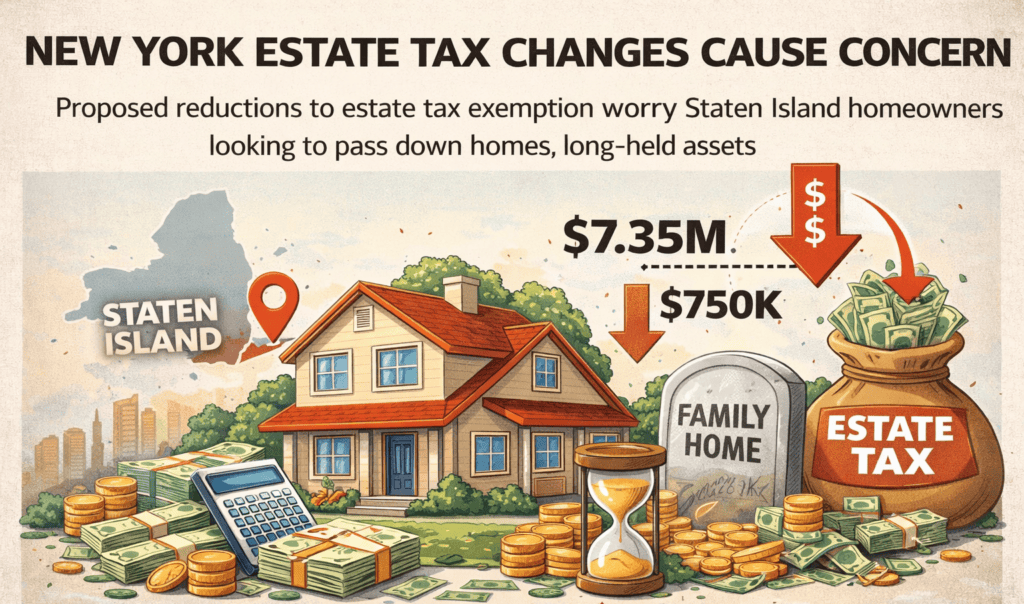
Rising living costs, tax concerns, and new policy proposals are adding to long-running affordability pressures for many local families.
For many Staten Island families, the cost of staying in New York already feels harder to manage than ever before. Between mortgage payments, property taxes, insurance, groceries, utilities, and transportation, the financial pressure has continued to build for households trying to hold onto long-term stability.
Now, a fresh round of policy concerns is adding to that strain.
One issue drawing particular attention is the future of estate taxes in New York. Under current state law, estates under $7.35 million are generally exempt from New York estate tax in 2026. A recently reported proposal, however, would lower that threshold to $750,000 while also sharply increasing the top tax rate on larger estates. For many Staten Island homeowners, that kind of change would raise serious concerns about whether passing down a family home or other long-held assets could become far more difficult.
That concern carries extra weight on Staten Island, where many families have spent decades building equity in homes they hoped would remain part of the family for generations. In many cases, rising property values may make a home look more valuable on paper, but that does not mean the household has the kind of disposable wealth needed to absorb major new tax consequences.
For residents focused on long-term planning, inheritance is not simply about wealth. It is often about preserving a family home, protecting savings, and passing something meaningful down to children and grandchildren after years of hard work. The idea that more of that value could be taxed away is one more reason some residents feel the financial ground beneath them is becoming less stable.
Transportation-related policies have also added to broader affordability concerns. Changes tied to traffic enforcement, speed regulations, and camera monitoring continue to frustrate many drivers, particularly in a borough where daily life depends more heavily on cars than in other parts of the city. For many Staten Islanders, driving is not optional. It is part of getting to work, managing family responsibilities, and moving through neighborhoods where public transit does not always offer the same convenience.
As a result, stricter enforcement measures can feel less like a small adjustment and more like another recurring cost layered onto an already expensive way of life.
Household and property-related rules have also become part of the larger affordability conversation. Even when proposals are framed around safety, energy use, or environmental goals, many homeowners still judge them based on how they affect daily life, personal control, and the cost of maintaining a home. For families already trying to keep up with rising expenses, additional regulations can feel like one more burden rather than a meaningful improvement.
The broader issue is whether Staten Island families still feel they can build a secure future in New York without being squeezed from every direction. For some residents, the borough remains worth it because of family roots, homeownership, and the strong sense of community that comes with living here. For others, the pressure is becoming harder to ignore.
What continues to stand out is that the concern is not centered on one single proposal. It reflects a wider feeling that the cost of staying, building, and passing something on in New York is becoming harder to justify. For many Staten Islanders, that growing pressure is shaping how they think about the future, not just for themselves, but for the next generation as well.
Read Next
More stories from around Staten Island

TFit Foundation Donates Commercial Fitness Equipment to Two Staten Island FDNY Firehouses

Lost Handbag Returned by Honest Staten Island Couple Restores Faith in Community